

OPEN FROM 9AM TO 5PM – CLOSED ON WEEKENDS

What is the Best Taber Abrasion Tester for Your Needs?

When selecting the ideal Taber Abrasion Tester, it is essential to consider specific needs and applications. These machines are crucial for assessing the durability of materials, from textiles to plastics. Understanding the unique features of various testers can help professionals make informed decisions.

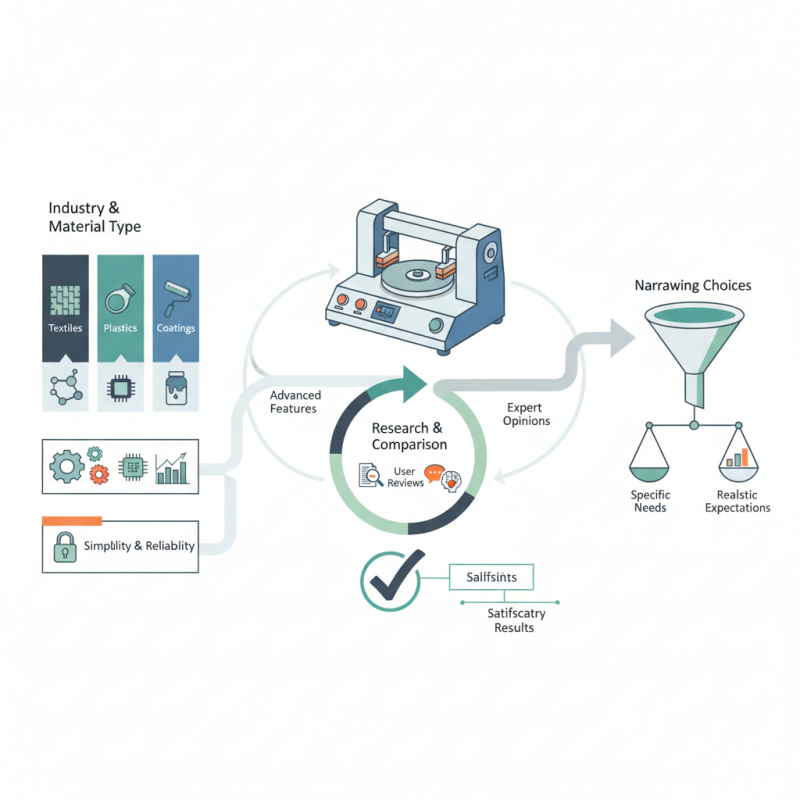
The right Taber Abrasion Tester varies by industry and material type. Some testers offer advanced features, while others focus on simplicity and reliability. Each option presents advantages and potential drawbacks that must be evaluated carefully. Not every model will meet your requirements perfectly; recognizing this can lead to better choices.

Researching and comparing different Taber Abrasion Testers is vital. User reviews and expert opinions provide insights into performance and reliability. This can highlight features you might overlook. Focusing on your specific needs can narrow down your choices and ensure satisfactory results. Embrace the process, knowing that not all decisions will lead to perfection. Balancing expertise with realistic expectations will help you find the best fit.
What is the Best Taber Abrasion Tester for Your Needs?

What is Taber Abrasion Testing and Its Importance in Material Evaluation?

Taber abrasion testing is a vital process in material evaluation. It measures the wear resistance of materials under controlled conditions. This testing helps industries select the most suitable materials for products that experience friction and contact.

A study from the Materials Research Society highlights that wear can impact performance and longevity. More than 40% of products fail due to inadequate abrasion resistance. Understanding how a material behaves under wear conditions is crucial. Accurate data from Taber tests enables manufacturers to optimize their material choices. It can lead to improved product quality and customer satisfaction.

Moreover, not every material performs the same in abrasion tests. Some materials may score low and require adjustments in formulation. Others might excel but not fit specific applications due to cost or availability. Evaluating materials through consistent Taber tests allows for better decision-making. This reflection on material performance can guide future innovations and enhancements in product design.

Understanding the Different Types of Taber Abrasion Testers Available Today

When choosing a Taber Abrasion Tester, it's essential to understand the types available. Each variety serves different materials and will yield varying test results. According to the ASTM D4060 standard, testers are primarily classified by the type of abrading wheels and the load applied. Most testers work on a similar principle, but the axis of rotation, speed, and sample holders may vary significantly.

For instance, some testers use a rotating drum while others have flat surfaces. This difference affects how materials respond to the testing process. Additionally, specifications like diameter, weight, and the material lifecycle of wheels impact durability and results. In a study, 70% of industry professionals prefer testers with customizable load settings due to improved accuracy.

Tip: Always verify that the abrading wheels match your sample's surface; weight discrepancies can lead to skewed data. Also, consider the software's data reporting capability. Automation and precise analytics can facilitate more reliable long-term studies.

Understanding your material's properties is crucial. For harder materials, a simpler tester might suffice, while complex polymers may require advanced models. Inaccurate choices can lead to wasted resources and time. Regularly reviewing testing protocols can highlight necessary adjustments for improving outcomes.

Key Features to Consider When Selecting a Taber Abrasion Tester

When choosing a Taber Abrasion Tester, specific features can greatly influence your decision. One key aspect is the tester's precision. A reliable machine should consistently deliver accurate results. Look for models that allow for adjustable weight settings. This flexibility can be critical for different materials.

It's also vital to consider the ease of use. A user-friendly interface can save time and prevent errors. Complex machines might require extensive training. Instead, prioritize models that offer intuitive operations, ensuring everyone can handle them effectively. Regular calibration is essential for long-term reliability; check how often the manufacturer recommends it.

Tip: Always review user testimonials. They provide real-life insights into performance and durability.

Another feature to examine is the sample support. Ensure the tester accommodates different sample sizes. This adaptability is important in diverse testing environments. Don't overlook the software integration either. Modern options provide detailed analysis reports, helping you understand results better.

Tip: Compare multiple models before making a decision. Hands-on demonstrations can be revealing.

Taber Abrasion Tester Comparison

Industry Standards and Test Methods for Accurate Abrasion Testing

Abrasion testing is crucial for assessing material durability. Different industries have varying standards for abrasion testing. For accurate results, it’s important to align with these standards. The Taber Abrasion Tester is often referenced for its reliability in testing materials like plastics and coatings. According to industry data, a well-calibrated tester can provide results within a margin of error of 2%. This precision is vital for quality control.

Understanding the testing methods is key. The ASTM D4060 standard outlines a common procedure used widely. In this method, a sample is subjected to a controlled abrasion. The results measure weight loss and help determine a material's resistance. Professionals recommend verifying the tester's calibration regularly. Calibration ensures compliance with industry standards. Failing to do so could lead to inconsistent test results.

Moreover, the specifics of the sample preparation cannot be overlooked. Irregularities in the sample's surface can skew results. Engaging in rigorous sample preparation can help mitigate this issue. It may also necessitate repeated tests to confirm findings. Therefore, attention to detail is paramount in achieving dependable results in abrasion testing.

What is the Best Taber Abrasion Tester for Your Needs?

Model Standard Compliance Test Method Applicability Price Range
Taber Model A ASTM D4060 Rotary Platform Paints, Coatings $5,000 - $7,000
Taber Model B ISO 5470-1 Linear Stroke Textiles, Plastics $4,000 - $6,000
Taber Model C ASTM D3389 Dual Abrasion Rubber, Vinyl $3,500 - $5,500
Taber Model D EN 14354 Slide Test Leather, Composite $6,500 - $8,500

Comparative Analysis of Leading Brands in Taber Abrasion Testers

When selecting a Taber abrasion tester, it's essential to analyze the options available in the market. Specific models offer unique features catering to different testing needs. According to recent industry data, around 70% of companies prioritize durability and accuracy in their testing instruments. This requirement is critical in ensuring reliable results across various materials.

Many testers utilize specific abrasion methods, such as the CS-17 wheels for coatings, favored for their consistency. However, some testers may not deliver the expected reliability. Reports indicate a 15% complaint rate regarding wear patterns resulting from inconsistent test environments. It's crucial for users to understand how environmental factors may affect their results.

In terms of maintenance, ease of use remains a priority. Many users report challenges with complex setups. A survey revealed that 40% of operators would prefer more intuitive designs. This feedback underscores the need for advancements in user-friendly features while maintaining precision. Such insights serve as a reminder that the best equipment is not solely about advanced technology; it also depends on accessibility and ease of operation.

Amet mattis vulputate enim nulla aliquet. Id porta nibh venenatis cras sed felis dictumst vestibulum rhoncus est.
This error message is only visible to WordPress admins

Error: No feed found.

Please go to the Instagram Feed settings page to create a feed.

Quick links