OPEN FROM 9AM TO 5PM – CLOSED ON WEEKENDS
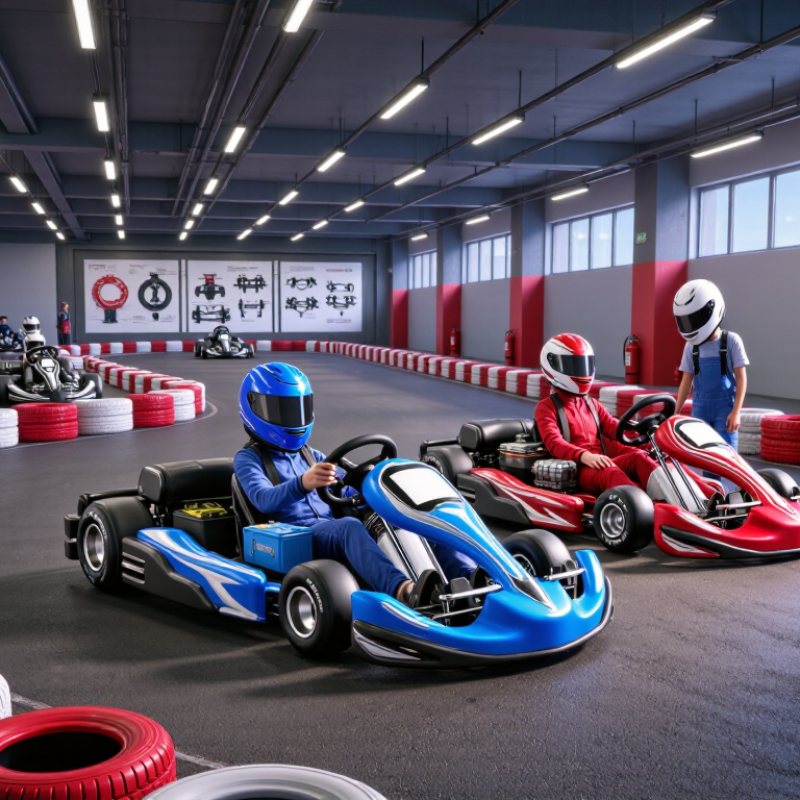
Choosing the right Karting Kart can shape your business’s safety, customer experience, and long-term operating costs. A suitable model should match your track design, customer profile, daily usage, and maintenance capacity. A family entertainment center may need durable, easy-to-control karts. A competitive circuit may require sharper handling and more precise performance. The fastest option is not always the best investment.
Real-world experience matters during this decision. Inspect the frame, steering system, brakes, tires, seat position, and protective bodywork. Ask suppliers about service intervals, replacement parts, warranty coverage, and technical support. A kart that looks impressive in a showroom may perform differently after hundreds of rental sessions. Test several units on your actual track, if possible. Watch how beginners accelerate, turn, and stop. Observe the kart closely.
Small details matter.
Electric and petrol-powered models also create different business demands. Electric karts can offer quieter operation, easier indoor use, and predictable energy management. Petrol models may provide familiar performance, but they require fuel handling, ventilation, and more routine mechanical care. Your local safety requirements and site conditions must guide this choice. Reliable manufacturers should provide clear specifications, user guidance, and documented safety information. Independent reviews and operator feedback can reveal weaknesses that marketing materials overlook. No checklist is perfect. Budget estimates can also fail when batteries, tires, downtime, and staff training are ignored. Build a realistic ownership plan before ordering. The strongest choice balances safety, reliability, driver enjoyment, and measurable business value.
Business needs should guide every karting decision, not maximum speed. A family entertainment center needs durable karts, simple controls, and adjustable seating. A competitive circuit needs sharper handling, consistent braking, and easy setup changes. Grand View Research’s 2024 Go-Kart Market report estimates steady market growth through 2030, suggesting stronger demand for repeatable, professionally managed experiences. However, growth alone does not guarantee profit. Your track length, daily sessions, customer age, and maintenance capacity matter more.
Calculate practical throughput before purchasing. A 12-kart fleet may support 120 riders per hour with five-minute sessions, loading time, and basic checks. That figure changes quickly when one kart leaves service. Electric karts can reduce local exhaust and simplify indoor operations, but charging space, battery replacement, and electrical capacity require planning. Combustion systems may offer longer continuous operation, yet ventilation and fuel procedures add responsibility. Choose equipment aligned with recognized safety guidance, including applicable ASTM standards and FIA Karting regulations. Local inspection rules still control.
Tips:
Track downtime for thirty days. Measure battery charging time, brake wear, tire replacement, and minor collision repairs. Ask suppliers for documented service intervals and parts availability. Inspect seat adjustment, steering response, emergency shutoff access, and chassis protection. Do not trust impressive acceleration alone. I once underestimated queue management; the karts were capable, but the pit area slowed every session. That mistake was expensive. Keep spare controls, tires, belts, and charging equipment on site. Reliability is often less exciting, but customers remember waiting.
How to Choose the Best Karting Kart for Your Business?
Kart types should match your track, customers, and operating rhythm. Rental karts need strong bumpers, simple controls, durable frames, and adjustable seats. Performance karts favor lighter chassis, responsive steering, and tunable suspension. Electric karts offer quiet operation and instant torque. Fuel-powered karts may suit longer sessions, but they require ventilation and more routine servicing. The best choice is rarely the fastest kart.
Compare specifications beyond top speed. Check motor output, battery capacity, charging time, or fuel consumption. A kart with 20 minutes of charging may disrupt busy weekend schedules. Examine brake design, tire size, wheelbase, ground clearance, and turning radius. These details affect control, tire wear, and track flow. Measure seat range carefully. A narrow seat can exclude customers, while excessive adjustment may weaken the frame.
Ask for service intervals and replacement-part availability before ordering. Inspect welds, pedal mounts, steering joints, and protective panels. Small defects become expensive across a large fleet. Safety systems should be easy to inspect between sessions. Data logging can reveal slow batteries, uneven braking, or repeated impacts. It is useful, but not perfect. Staff still need practical checks. A lower purchase price may seem attractive, yet downtime can cost more than the original saving. Test one kart on your actual track, with different drivers, before committing to a full fleet.
| Kart Type | Typical Business Use | Powertrain | Typical Motor or Engine Output | Typical Top Speed | Typical Session or Operating Time | Charging or Refueling | Maintenance Profile | Noise and Emissions | Best Fit for a Business | Key Specifications to Compare |
|---|---|---|---|---|---|---|---|---|---|---|
| Electric Rental Kart | Indoor and outdoor commercial tracks, family entertainment centers, and mixed-age public sessions. | Battery-electric drive with a single rear motor; commonly designed with selectable speed modes. | Approximately 4–15 kW continuous or peak motor rating, depending on kart size and operating mode. | Approximately 25–60 km/h, usually configurable for junior, standard, and advanced sessions. | Typically 20–60 minutes per charge under repeated commercial use; actual time depends on battery capacity, speed settings, and track layout. | Usually 4–10 hours with standard charging equipment; businesses may use spare battery packs or opportunity charging. | Generally low mechanical maintenance; routine checks include brakes, tires, steering components, battery condition, and electrical connections. | Very low local emissions and substantially quieter than combustion-powered karts, making it suitable for many indoor venues. | High-throughput rental operations that value low noise, adjustable performance, and simpler daily operation. | Battery capacity, charging time, thermal management, speed control, emergency stop system, bumper design, seat adjustment, and parts availability. |
| Gasoline Rental Kart | Outdoor commercial tracks, larger recreational venues, and facilities where rapid turnaround between sessions is important. | Four-stroke gasoline engine with chain or direct drive and centrifugal clutch or comparable automatic engagement system. | Approximately 5–15 hp for common recreational rental configurations. | Approximately 30–70 km/h, depending on gearing, engine output, track rules, and driver restrictions. | Several hours of operation between refueling and scheduled service intervals; runtime is not limited by battery charging. | Refueling commonly takes a few minutes, but fuel storage, ventilation, spill control, and fire-safety procedures are required. | Moderate maintenance; oil changes, air filters, spark plugs, belts or chains, clutches, brakes, and exhaust components require regular inspection. | Higher noise and exhaust emissions than electric models; generally better suited to outdoor sites with appropriate ventilation and regulatory approval. | Outdoor businesses that need fast refueling and long continuous operating hours. | Engine durability, fuel consumption, governor or speed limiter, cooling system, exhaust compliance, drivetrain protection, and service access. |
| Junior Electric Kart | Children’s sessions, family entertainment centers, beginner programs, and supervised training areas. | Battery-electric drive with programmable speed and acceleration limits. | Approximately 2–8 kW, depending on the kart’s size, weight rating, and performance configuration. | Approximately 15–35 km/h, with speed normally restricted to suit age, driver ability, and track design. | Often 30–90 minutes of practical session use per charge, depending on battery size and speed settings. | Commonly 4–10 hours for a full charge; a spare-kart rotation plan can maintain operating availability. | Low mechanical maintenance, with particular attention to brake adjustment, steering alignment, tires, restraints, and battery safety. | Quiet operation and no tailpipe emissions, which is beneficial for indoor areas and venues serving families. | Businesses targeting younger drivers and requiring strong speed control and easy supervision. | Adjustable speed modes, parental or operator controls, seat and pedal adjustment, protective bumpers, safety belt options, and maximum rider height or weight. |
| Two-Stroke Sprint Racing Kart | Competitive outdoor circuits, driver training, racing schools, and organized amateur or professional events. | Lightweight two-stroke engine with direct drive, manual clutch, and chain transmission. | Approximately 15–45 hp, depending on engine class, tuning, and race regulations. | Approximately 80–140 km/h, depending on engine class, gearing, circuit length, and aerodynamic setup. | Usually suitable for short race heats or practice sessions; fuel range depends on tank capacity, engine tune, and session length. | Refueling is quick, but fuel mixture, engine setup, and post-session inspection require trained staff. | High maintenance compared with rental karts; piston, clutch, chain, bearings, brakes, tires, and chassis alignment require frequent attention. | High noise and combustion emissions; normally intended for outdoor facilities with suitable operating permissions. | Specialist racing businesses that can support technical preparation and frequent component replacement. | Engine class, chassis homologation, braking system, tire regulations, fuel capacity, spare-part supply, driver protection, and compliance with event rules. |
| Four-Stroke Competition Kart | Endurance karting, arrive-and-drive racing, driver development, and lower-maintenance outdoor competition programs. | Four-stroke gasoline engine, commonly paired with automatic or centrifugal clutch and chain drive. | Approximately 5–20 hp, depending on the competition category and engine specification. | Approximately 50–100 km/h, depending on gearing, chassis setup, track configuration, and regulations. | Often suitable for extended sessions with fuel stops planned around race format and tank capacity. | Refueling generally takes a few minutes; fuel handling and outdoor safety controls are required. | Moderate to high maintenance; oil, filters, clutch, chain, brakes, tires, and chassis components need scheduled inspection. | Typically louder and more polluting than electric karts, but often less demanding to operate than high-performance two-stroke systems. | Businesses offering structured racing experiences with durability and endurance as priorities. | Engine service interval, fuel consumption, clutch durability, chassis strength, braking performance, tire life, and ease of fleet standardization. |
| Two-Seat or Tandem Kart | Family rides, instructor-led experiences, accessible programs, and venues serving passengers who cannot drive independently. | Electric or gasoline powertrain; configuration varies by operating environment and local safety requirements. | Approximately 4–15 kW for electric versions or 5–15 hp for gasoline versions. | Approximately 20–50 km/h, normally limited to prioritize stability and passenger safety. | Electric versions typically provide 20–60 minutes of active use per charge; gasoline versions can operate for several hours between refueling stops. | Charging time varies by battery system; gasoline variants require rapid refueling procedures and approved fuel storage. | Higher inspection requirements because of increased vehicle weight and passenger capacity; check restraints, seating, steering, brakes, and frame integrity. | Electric versions are quieter and produce no local tailpipe emissions; gasoline versions require outdoor operation or suitable ventilation. | Family-oriented venues, introductory programs, and businesses that want to broaden customer access. | Weight capacity, seat spacing, restraint system, rollover protection, turning radius, braking distance, low-speed stability, and operator visibility. |
| Off-Road Utility Kart | Adventure parks, resort activities, private-site transport, guided trail experiences, and uneven-terrain recreation. | Electric or gasoline powertrain with reinforced chassis, larger tires, and increased ground clearance. | Approximately 5–25 kW for electric versions or 8–25 hp for gasoline versions. | Approximately 25–65 km/h, depending on terrain, gearing, suspension, and safety policy. | Electric runtime often ranges from 1–4 hours of mixed operation; gasoline versions can run for several hours between refueling stops. | Electric charging may take 4–10 hours; gasoline models offer faster turnaround but require fuel-management procedures. | Moderate maintenance; inspect suspension, steering joints, wheel bearings, tires, brakes, chassis, and underbody protection. | Electric models minimize local noise and emissions; gasoline versions are generally more suitable where charging infrastructure is limited. | Businesses operating on large outdoor properties or offering guided off-road experiences. | Ground clearance, suspension travel, tire pattern, traction, water resistance, payload rating, hill-climbing capability, and protective structure. |

Comparison note: Specifications are typical industry ranges rather than fixed standards. Actual performance depends on vehicle configuration, rider weight, battery condition, gearing, track layout, climate, maintenance, and applicable local safety regulations.
How to Choose the Best Karting Kart for Your Business?
Safety, Durability, and Maintenance Considerations
Safety should guide every purchasing decision, not only the advertised speed. Inspect the frame for clean welds, secure bumpers, and protected moving parts. Test the steering for smooth control and excessive play. Brakes must respond evenly without unusual noise. Seat belts, helmets, and emergency shut-off systems also require regular inspection. Check it cold. A kart that feels fine after warming up may hide a starting problem.
Durability depends on more than a strong frame. Choose components that can tolerate repeated impacts, dust, vibration, and long operating hours. Reinforced steering joints and replaceable body panels can reduce downtime. Tires should offer predictable grip across your track surface. In my experience, small faults grow quickly during busy weekends. A loose wheel nut can become a serious safety concern. Still, no kart remains reliable without disciplined care.
Create a written maintenance schedule before the fleet arrives. Record brake checks, tire wear, battery condition, fastener torque, and steering alignment. Train staff to report unusual smells, vibrations, or slower braking immediately. Use qualified technicians for complex repairs, and follow the equipment manual closely. Local safety requirements may also affect inspections and protective equipment. I have sometimes underestimated cleaning time, especially around axles and pedal areas. That mistake can shorten component life. Build spare parts, inspection time, and staff training into the operating budget.
Compare common commercial kart types across the factors that most directly affect operating safety, service life, and day-to-day maintenance. Scores use a practical 0–100 procurement benchmark, where higher values indicate a stronger business fit.
Electric rental karts score highly for maintenance simplicity because they have fewer moving parts and no fuel or engine-oil service. Gasoline rental karts can provide long operating range but require more routine mechanical care. Junior karts should be selected with particular attention to speed control, braking performance, protective equipment, and operator supervision.
How to Choose the Best Karting Kart for Your Business?
Budget, Ownership Costs, and Supplier Support
A low purchase price can hide expensive operating problems. I have seen rental operators underestimate tire wear, brake replacement, charging equipment, and routine inspections. Build a three-year ownership budget before comparing models. Include electricity, spare parts, technician time, insurance, storage, and expected downtime. Every kart needs care.
Battery life deserves close attention. Ask how performance changes after repeated daily charging. Request service records from similar commercial fleets, not only showroom demonstrations. A kart that runs smoothly for ten minutes may struggle after six hours. Test it under realistic loads and track conditions. Record the results.
Supplier support can protect revenue when the track is busy. Confirm parts availability, response times, technician training, and warranty procedures in writing. Ask whether common components can be replaced without specialized tools. A clear parts list helps your team prepare. So does practical training.
Do not judge support by friendly sales conversations alone. Call the service department with a technical question. Notice how quickly and clearly they respond. I once treated a promised delivery date as guaranteed, which created avoidable delays. That mistake changed my purchasing process. Now I check references from operators with similar fleet sizes and weather conditions. Reliable support is measurable through response records, repair times, and honest communication.
Choosing the best kart for your business requires controlled testing, not attractive specifications alone. Test each kart on your actual track surface, including tight corners, uneven sections, and long straights. Record lap times, braking stability, steering response, energy use, and driver comfort. A stopwatch helps, but it cannot measure every business concern.
During evaluation, invite experienced operators and different driver types. Watch how beginners reach the pedals, enter corners, and recover from small mistakes. Check seat adjustment, visibility, protective structure, charging access, tire wear, and maintenance time. I once focused too heavily on speed and underestimated repair delays. That decision would have reduced daily availability. Real-world testing can expose these blind spots.
Tips: Run repeated sessions with cold and warm components. Inspect fasteners, brakes, steering, and tires after every session. Keep a simple test sheet with dates, driver comments, lap times, and observed faults. Ask technicians to estimate routine service hours and replacement costs. Do not trust one excellent run. Three consistent sessions are more useful. Also, leave space for honest criticism. A kart may feel powerful but still be tiring, noisy, or difficult for smaller drivers. Select the model that delivers dependable handling, manageable upkeep, and consistent performance across a full operating day.