

How to Choose the Best Truck Paint Booth?
Choosing the best truck paint booth requires more than comparing prices and advertised dimensions. A suitable booth must match the truck’s size, paint process, production volume, and available workspace. A long-wheelbase truck needs enough length for safe door clearance and technician movement. Tall cabs also require careful attention to internal height. Small mistakes can create serious workflow problems.
Experienced operators usually examine airflow, filtration, lighting, heating, and exhaust performance before selecting equipment. Even air movement matters. Uneven airflow can leave dust on a newly painted door or create inconsistent finishes across a trailer. Bright, balanced lighting helps technicians identify color differences, sanding marks, and surface defects. Reliable filters and accessible maintenance points reduce downtime. Technical data, installation records, warranty terms, and manufacturer support should be reviewed carefully.
Safety and compliance must remain central to the decision. The booth should support approved coatings, proper ventilation, fire protection, and local workplace requirements. Qualified installers can verify electrical systems, exhaust routes, and foundation conditions. It is tempting to choose the largest booth available, but that decision may waste energy and floor space. A smaller model may also limit future work. There is no perfect choice. The best truck paint booth fits current operations while allowing realistic growth, dependable maintenance, and consistent finishing results. Reviewing real production conditions, not just brochures, leads to a more trustworthy investment.
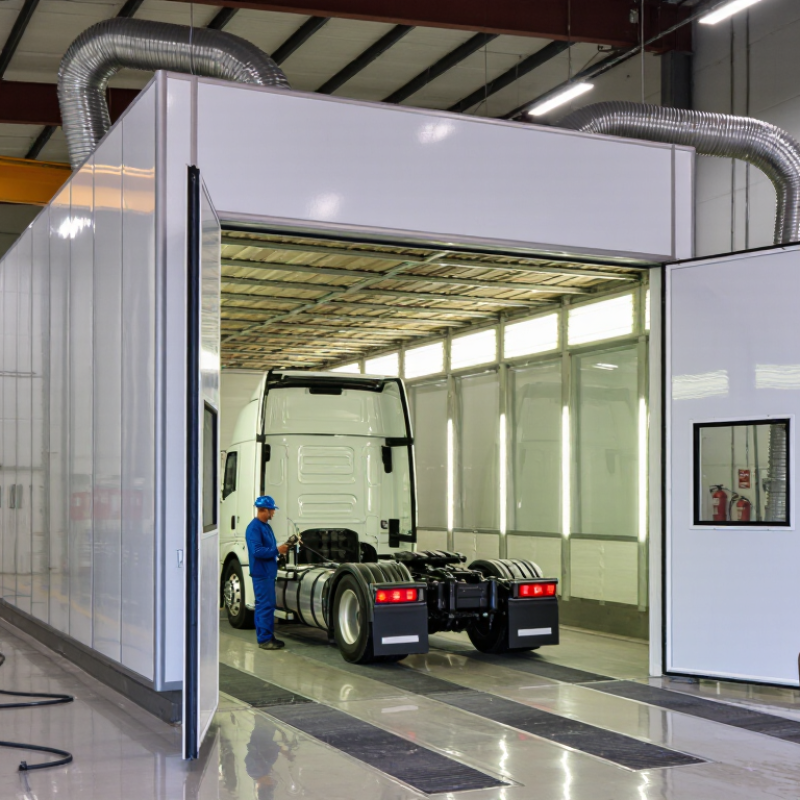
Understand the Main Types of Truck Paint Booths
Truck paint booths come in several configurations, and each handles airflow differently. Understanding these types makes selection more practical.
A downdraft booth pulls air from the ceiling and directs paint particles toward a floor-level exhaust system. This airflow usually produces a cleaner finish on large truck panels. It also reduces overspray settling on wet surfaces. However, it often requires a deep pit or raised floor. Construction costs can increase quickly.
A crossdraft booth moves air horizontally from the front toward the rear. Its layout is simpler and often more affordable. It suits repair shops with limited building changes. Yet, airflow may pass across freshly painted doors and create uneven results. A side-downdraft booth combines ceiling supply with lower side exhaust. It offers better particle control without always needing a full pit. Many truck refinishing facilities find this a useful compromise.
Open-front booths use filtered intake air and a controlled exhaust wall. They work well for smaller repairs, but full truck painting can challenge their airflow capacity. Measure the truck, including mirrors, ladders, and raised equipment. Leave enough clearance for technicians to move safely. Check fan performance, filter access, lighting, and temperature control. A booth may look powerful on paper but perform poorly with blocked filters. No layout is perfect. I would also review daily cleaning habits, because neglected floors can undermine an otherwise well-designed system. Choose the booth type that matches truck size, production volume, building structure, and verified ventilation requirements.
How to Choose the Best Truck Paint Booth? - Understand the Main Types of Truck Paint Booths
| Truck Paint Booth Type | Airflow Direction | Typical Truck Applications | Finish Quality | Overspray Control | Main Advantages | Main Limitations | Space and Installation Considerations | Best Choice When |
|---|---|---|---|---|---|---|---|---|
| Downdraft Booth | Air enters through the ceiling and moves vertically downward to a filtered exhaust pit or basement. | Complete truck repainting, buses, trailers, and high-value commercial vehicles. | ★★★★★ Excellent | Very high, because overspray is pulled away from painted surfaces and workers. | Produces a clean, uniform finish; minimizes dust circulation; provides excellent visibility during spraying; supports premium refinishing work. | Usually has the highest purchase and installation cost; requires suitable pit, trench, or raised-floor construction; needs regular filter maintenance. | Requires substantial ceiling height, floor preparation, exhaust planning, and adequate building space for the airflow system. | Finish quality and contamination control are more important than the initial installation budget. |
| Semi-Downdraft Booth | Fresh air enters mainly through the front ceiling area and flows downward and toward rear or lower exhaust filters. | Truck panels, medium-duty trucks, trailers, and general commercial-vehicle refinishing. | ★★★★☆ Very Good | Good, although generally less consistent than a full downdraft design. | Offers a useful balance between finish quality, airflow performance, and installation cost; usually requires less structural work than a full downdraft booth. | Airflow can be less uniform near the rear or lower sections; results depend strongly on correct booth loading and filter condition. | Needs sufficient booth length and ceiling clearance, but commonly avoids the deep exhaust pit required by some downdraft systems. | A workshop wants strong finish quality without the full cost and construction requirements of a downdraft booth. |
| Crossdraft Booth | Air moves horizontally from filtered intake panels at the front toward exhaust filters at the rear. | Routine truck repairs, fleet maintenance, spot repairs, and high-throughput production work. | ★★★☆☆ Good | Moderate; overspray travels across the vehicle before reaching the exhaust filters. | Simple airflow layout; comparatively straightforward installation; generally lower initial cost; suitable for many standard repair operations. | The finish may be more sensitive to dust and overspray movement; paint buildup on rear filters can increase operating resistance. | Requires adequate booth length and clear front-to-rear airflow; intake and exhaust locations must be planned to prevent interference with nearby work areas. | The priority is economical, dependable truck painting for routine repairs rather than the highest possible finish standard. |
| Side-Downdraft Booth | Air enters from the ceiling and is drawn downward toward exhaust plenums or filters positioned along the side walls. | Large trucks, buses, trailers, and facilities where a below-floor exhaust pit is impractical. | ★★★★☆ Very Good | High, with effective removal of overspray from the central work zone. | Provides near-downdraft finish performance; avoids a full-length floor pit; can be suitable for existing buildings with limited excavation options. | Side exhaust plenums require additional wall space; airflow balance and filter maintenance are important for consistent results. | Needs sufficient width for side exhaust channels and service access; the floor can often remain level compared with pit-style downdraft systems. | A facility needs high-quality airflow but cannot install a conventional below-floor downdraft exhaust system. |
| Open-Face Prep or Touch-Up Booth | Air is drawn from the open front across the work area toward a filtered rear exhaust wall. | Small truck parts, bumpers, wheels, spot repairs, sanding, masking, and preparation work. | ★★☆☆☆ Limited for Full Painting | Moderate for localized work; lower containment than a fully enclosed booth. | Easy access for large or irregular parts; lower construction complexity; useful for preparation and limited touch-up operations. | Does not provide the same containment, cleanliness, or process control as an enclosed spray booth; may not be suitable for complete truck painting or regulated spraying. | Requires a dedicated exhaust arrangement, make-up air planning, suitable clearances, and compliance with local fire and environmental requirements. | The work involves preparation or small-area repairs, not frequent complete-vehicle spraying. |
Related Posts
-
10 Truck Paint Booth Buying Tips for Global Buyers
-

Top Powder Coating Equipment Package Options for Your Needs?
-
2026 Best Paint Booths for Global Buyers What to Consider?
-

What is an Overhead Conveyor and How Does It Benefit Your Business?
-
2026 Top Powder Coating Booth for Sale Options to Consider?
-
Why You Should Consider Buying a Paint Booth for Sale for Your Business
