

OPEN FROM 9AM TO 5PM – CLOSED ON WEEKENDS
Choosing the best Weighing Packing Machine in China requires more than comparing prices or advertised speed. The right machine must match the product, target weight, bag style, factory environment, and service expectations. This matters because global packaging machinery demand continues to expand. Mordor Intelligence estimates the market will grow at a compound annual rate of about 5.6% from 2024 to 2029. That growth reflects stronger automation needs across food, agricultural, chemical, and consumer goods production.
China offers a wide range of weighing and packing equipment. Some manufacturers focus on multihead weighers for snacks, grains, frozen foods, and hardware parts. Others develop linear scales, premade pouch systems, or complete vertical packaging lines. PMMI industry reports repeatedly highlight labor shortages, hygienic design, faster changeovers, and data visibility as major packaging priorities. Therefore, the best machine is not always the fastest model. It should deliver stable accuracy, practical cleaning access, reliable sealing, and measurable uptime. A useful test includes repeated weighing, bag-drop inspection, and performance checks with the customer’s actual product.
Small details often reveal engineering quality. Watch the product flow through each hopper. Check whether powder gathers around the load cell. Ask how quickly operators can change from 500 grams to one kilogram. Confirm spare-part availability and remote support before signing a purchase agreement. No machine wins every application. A polished quotation can still hide weak commissioning support. This guide compares key machine types, technical indicators, supplier experience, and lifecycle costs, helping buyers make a more balanced decision. The final choice should be based on verified trials, not impressive brochures alone.
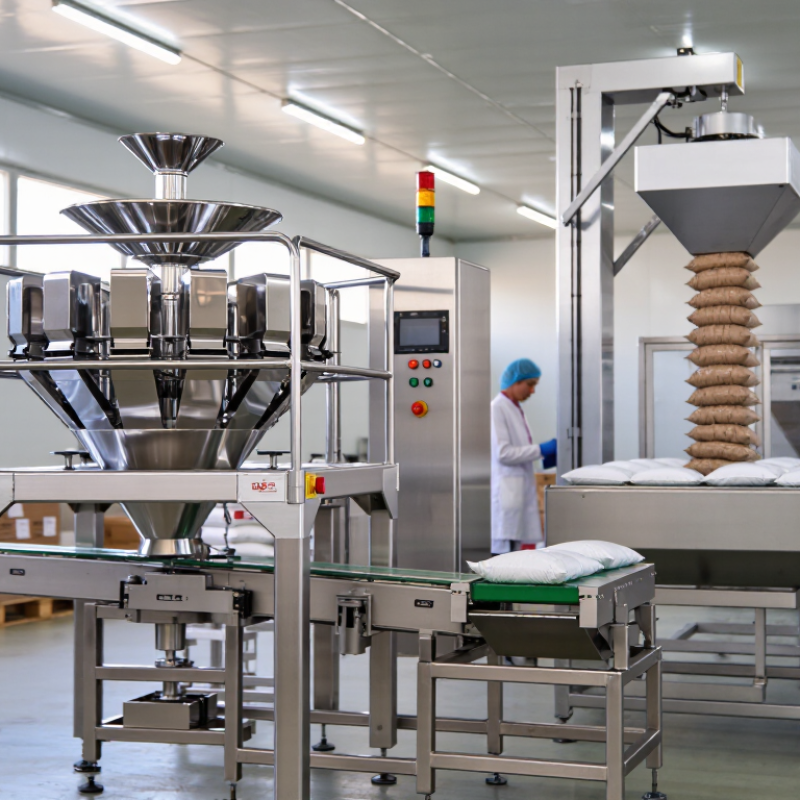
China’s best weighing packing machine is defined by measurable performance, not a polished catalogue. It should maintain stable weight, protect product quality, and adapt to changing pack sizes. The World Robotics 2024 report recorded 276,288 industrial robot installations in China during 2023. This figure shows strong automation demand, but automation alone proves little. A reliable machine still needs accurate load cells, responsive software, and simple operator controls.
In practical trials, buyers should test the actual product, including dust, moisture, and irregular particles. Check weight deviation across repeated runs. Record speed, rejected packs, cleaning time, and seal consistency. PMMI’s 2024 State of the Industry report highlights labor efficiency, uptime, and digital connectivity as major packaging machinery concerns. Therefore, useful equipment should provide fault records, remote diagnostics, and quick format changes. OIML R 61 also offers a recognized reference for automatic weighing instruments. Compliance should be verified, not assumed.
A perfect machine does not exist. I would distrust any supplier promising zero waste or permanent accuracy without conditions. Ambient temperature, product flow, and operator habits can change results. A strong evaluation includes a factory acceptance test and several hours of continuous operation. The best weighing packing machine is the one that keeps acceptable accuracy after cleaning, adjustment, and routine mistakes. That sounds less impressive, but it reflects real production.
What Is the Best Weighing Packing Machine in China?
For precise filling, a multihead weigher is often the strongest choice. Its software combines several hopper weights, selecting the nearest total to the target. A 500-gram pack with ±0.1% accuracy allows only ±0.5 gram variation. At ±0.5%, the permitted range becomes ±2.5 grams. Load-cell stability, vibration control, and product flow determine whether those figures remain realistic.
The machine weighs continuously, not just once. It samples product in small batches, opens selected hoppers, and recalculates the next combination within milliseconds. Modern systems commonly use 10 to 32 heads, depending on product and output needs. OIML R 61 provides a recognized framework for automatic weighing instruments, although it does not guarantee identical results for every product. Sticky snacks, irregular pieces, and dusty powders remain difficult.
Data supports careful investment. The FAO’s 2023 State of Food and Agriculture reported that 13.2% of food was lost before retail in 2022. Accurate dosing can reduce giveaway, but weighing alone cannot solve poor handling. PMMI’s 2024 industry reporting also identifies labor availability and automation as continuing packaging concerns. Operators still need frequent calibration, clean contact surfaces, and controlled product feeding. That target is not magic. A factory may advertise ±0.1%, yet achieve less in daily production. Trial tests with the actual product matter more than a catalog specification.
| Multihead Weigher Configuration | Typical Target Weight Range | Typical Accuracy Range | Typical Throughput | Suitable Product Characteristics | Main Accuracy Factors | Recommended Application |
|---|---|---|---|---|---|---|
| 10-head weigher | 10–1,000 g | Approximately ±0.3–0.5% | Up to approximately 60 weighments per minute | Dry, free-flowing products such as grains, seeds, sugar, and small snacks | Load-cell resolution, product flow consistency, feed-gate timing, and the number of available combinations | Entry-level or medium-speed packing lines with moderate production requirements |
| 14-head weigher | 10–2,000 g | Approximately ±0.2–0.4% | Approximately 50–90 weighments per minute | Snacks, frozen foods, confectionery, pet food, and other products with stable flow | Accurate hopper calibration, optimized combination algorithms, stable vibration, and correct product distribution | General-purpose lines requiring a balance between accuracy, speed, and equipment cost |
| 16-head weigher | 10–2,500 g | Approximately ±0.2–0.3% | Approximately 60–100 weighments per minute | Mixed snacks, nuts, dried foods, frozen vegetables, and irregular-shaped products | More combination options, individual hopper stability, vibration control, and consistent product replenishment | High-volume packaging where improved combination flexibility reduces giveaway |
| 20-head weigher | 10–3,000 g | Approximately ±0.1–0.3% | Approximately 70–120 weighments per minute | High-value snacks, premium nuts, mixed products, and products with variable piece weights | Greater combination availability, high-resolution load cells, synchronized discharge, and precise feed control | High-speed production lines where minimizing product giveaway is a priority |
| 24-head weigher | 10–5,000 g | Approximately ±0.1–0.2% | Approximately 80–140 weighments per minute | Complex mixtures, fragile products, large-volume packs, and products with wide weight variation | Large combination pool, carefully tuned vibration profiles, stable product temperature, and rigorous calibration | High-precision, high-output lines with demanding product-mix or weight-tolerance requirements |
| Linear weigher | 50–5,000 g | Approximately ±0.5–1.5% | Approximately 10–40 weighments per minute | Products with relatively uniform flow and applications with less demanding accuracy requirements | Single-channel dosing control, product bulk density, material consistency, and timing accuracy | Lower-speed lines, coarse products, or applications where simple operation is more important than minimum giveaway |
Note: The figures are representative engineering ranges for properly configured equipment under stable operating conditions. Actual performance depends on product density, particle size, moisture, target weight, hopper design, calibration, vibration settings, packaging film, and operator setup. Accuracy is normally evaluated as the deviation from the programmed target weight over a defined sample set.
The best weighing packing machine in China depends on the product, target speed, and acceptable giveaway. A 30–60 weighment-per-minute linear weigher suits fragile snacks, powders, and short production runs. It is mechanically simple. However, operators may need more frequent adjustments.
A 60–100 weighment-per-minute multihead weigher offers better flexibility for granules, nuts, and frozen foods. Its combination of hoppers reduces average weighing error, but setup quality remains critical.
At 100–120 weighments per minute, twin-discharge or continuous systems can support demanding lines. The packing machine must match that speed. Otherwise, the weigher only creates a queue.
Vorne’s OEE Industry Standard report identifies 85% OEE as world-class performance and roughly 60% as a common average. At 120 weighments per minute, this suggests about 102 or 72 effective cycles per minute, assuming one pack per cycle. Actual output will fall with film changes, rejected weights, and cleaning.
PMMI’s 2024 State of the Industry report also highlights labor pressure and uptime as major automation drivers. These findings make service access, recipe control, and changeover time as important as headline speed.
A factory test should record 30-minute output, weight deviation, rejected packs, and restart time. Speed claims can look impressive. The data may tell a different story.
What Is the Best Weighing Packing Machine in China?
Choosing a weighing packing machine in China starts with the product, not the machine name. Granules, powder, and fragile pieces behave differently during filling. Dry rice may flow smoothly, while flour can bridge inside the hopper. Sticky products often need polished contact surfaces and wider discharge paths. Film thickness also matters. Thin film may seal quickly but can wrinkle under tension.
Load range is equally important. A machine designed for 5–50 grams may not deliver stable results at 2 kilograms. Check the target weight, allowable error, and filling speed together. A suitable load cell should provide clear readings without operating near its maximum capacity. In practical testing, I would compare ten consecutive fills at low, medium, and high speeds. Record every result. One test is not enough. Product density can change during a production shift.
IP65 protection offers useful protection in dusty packing areas. It prevents dust entry and withstands water jets from limited directions. It does not permit immersion or careless pressure washing. Inspect door seals, cable glands, and weighing sensors regularly. A sealed cabinet cannot compensate for poor cleaning habits. This is where specifications can mislead. A machine may carry an IP65 rating, yet nearby openings remain vulnerable. Request inspection records, calibration procedures, and material certificates before purchase. Then test the machine with your actual product and packaging film.
What Is the Best Weighing Packing Machine in China?
Selecting the best weighing packing machine starts with your product, not the machine’s appearance. In packaging line audits, I compare target weight, product flow, speed, and acceptable giveaway. A low purchase price can hide higher film waste, labor costs, and maintenance downtime. Calculate ROI using daily output, staffing, energy use, rejected packs, and expected service life. Small errors matter.
Automation level should match your actual production volume. A semi-automatic machine may suit seasonal products or frequent product changes. A fully automatic line can reduce labor and improve consistency at higher volumes. However, automation adds sensors, controls, and maintenance points. More automation is not always better. Sometimes, it becomes expensive overengineering.
Product behavior also determines the weighing system. Granules may need fast multi-head weighing, while powders require controlled feeding and dust management. Sticky or fragile products need gentler contact and carefully selected surfaces. Ask for product trials using your real material. Review weight records, sealing quality, cleaning time, and changeover steps. Request a factory acceptance test before shipment, with agreed performance limits. I would also inspect electrical safety, guarding, documentation, spare parts, and remote support. One honest weakness remains: laboratory results may not match humid factory conditions. Test twice.
Selecting the best machine by ROI, automation level, and product needs
The benchmark compares common machine configurations by typical production speed and estimated payback period. Throughput figures represent practical operating ranges for standard dry products, while payback estimates assume two shifts per day, approximately 300 operating days per year, reduced manual labor, and lower product giveaway. Actual results depend on product characteristics, package size, labor costs, and line configuration.

