China Top 10 Overhead Conveyor Manufacturers?
China’s overhead conveyor market matters because factories need reliable movement between workstations, not just faster transport. A painted frame, chain, trolley, and overhead rail can shape how smoothly parts move through a crowded plant. The right system may save floor space and reduce manual handling. The wrong one can complicate maintenance and production changes.
Grand View Research valued the global conveyor systems market at USD 10.3 billion in 2023. Its Conveyor Systems Market report projects a 4.5% compound annual growth rate from 2024 to 2030. This figure covers conveyor systems broadly, not overhead equipment alone. MHI’s 2024 Annual Industry Report also points to sustained investment in supply-chain innovation. These reports offer useful context, but they do not prove that every Chinese supplier has the same capabilities.
This guide examines ten Chinese overhead conveyor manufacturers through practical criteria: system range, engineering experience, customization, service support, and documented project evidence. Buyers should also check load limits, line layout, operating environment, spare-parts access, and commissioning plans. A polished product page is not enough. Ask for drawings and references. Verify the details. Rankings can simplify a complex market, and no single list fits every factory. That distinction is easy to miss.
Define Overhead Conveyor Types and Metrics: kg per Trolley, m/min, and Track Length
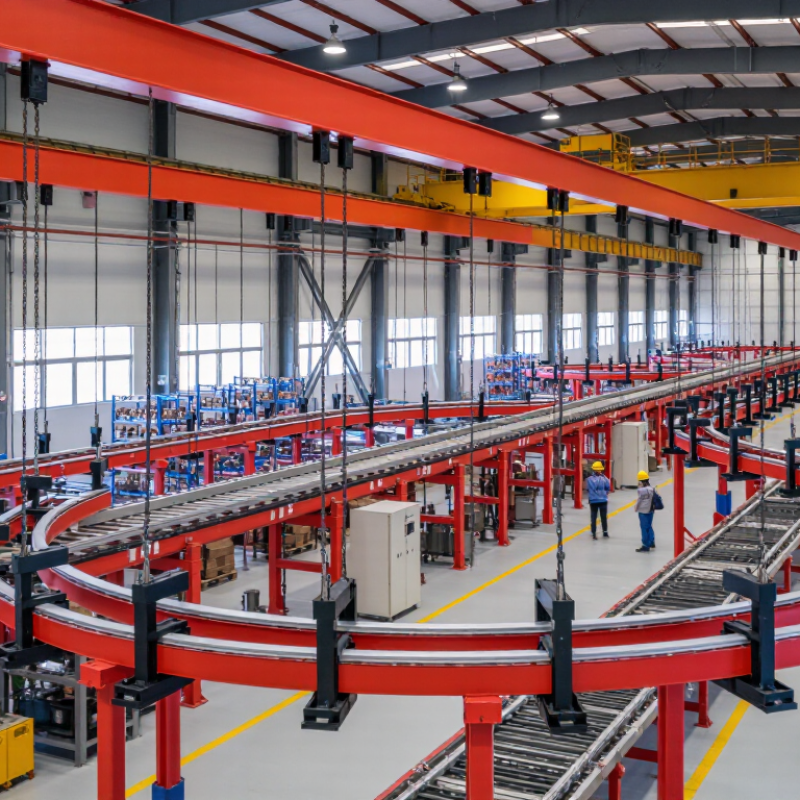
Overhead conveyors move loads above floor level, freeing space for people and mobile equipment. Common designs include enclosed-track systems for lighter carriers, monorails for continuous flow, and power-and-free systems for controlled accumulation or routing. Compare them by application, not name alone. MHI’s 2024 Annual Industry Report found that 55% of respondents planned to increase supply-chain technology investment. That signals interest in automation, but does not prove a conveyor suits every facility.
Three metrics make supplier quotes easier to compare. Kg per trolley is the rated load on each carrier, including the fixture; check whether the figure changes on curves or inclines. Speed, in m/min, describes chain travel, not necessarily finished units per minute. At 3 m/min with 1.5 m carrier spacing, the theoretical rate is two carriers per minute, before loading delays. Track length should state whether it means the full circuit or only the working route. A 180 m circuit at 3 m/min takes about 60 minutes per loop, without stops. Small distinction. MHI’s 2023 report said 87% of surveyed supply-chain professionals expected robotics and automation adoption within five years. Still, I would verify actual load, spacing, and stoppage assumptions on the plant layout; paper calculations can look cleaner than production.
How to read the chart: Bars show indicative speed ranges for common overhead conveyor types, not a manufacturer ranking or a universal specification. Actual operating limits depend on system design, load, process, and safety requirements.
Key metrics: kg per trolley is the rated load carried by one trolley; m/min is conveyor speed; track length is the total installed route length. Trolley capacity and track length are project-specific and should be confirmed with the system designer.
Profile China’s Top 10 Manufacturers by System Type and Target Industry
A useful profile of China’s top ten overhead conveyor manufacturers should compare engineering focus, not just factory size. Some specialize in enclosed-track systems for garment handling and light assembly. Others build I-beam or power-and-free conveyors for automotive plants, where carriers must move heavy parts between workstations. Monorail designs suit paint shops and compact production lines. Fit matters.
Several manufacturers focus on food and beverage facilities, supplying corrosion-resistant components and layouts that support routine washdowns. Others target appliance, electronics, or furniture production, where controlled spacing and predictable delivery can reduce manual handling. Inverted conveyors may suit finishing lines with limited overhead clearance, while higher-capacity systems often serve automotive and metalworking operations. Each design solves a different problem.
A fair comparison should examine load capacity, chain speed, curve geometry, controls, installation support, and access to replacement parts. Ask for layout drawings and references from similar industries; a polished catalogue is not proof of reliable performance. Some suppliers cover several system types, so neat categories can be misleading. “Top ten” is also not a verified ranking unless selection criteria and project data are disclosed. Teams should check those details before treating any profile as a recommendation.
Compare Rated Load, Throughput (units/h), Line Speed, and Installation Footprint
A meaningful comparison of ten overhead conveyor manufacturers starts with the load each system must carry, not a headline capacity. Check whether rated load refers to each carrier, each trolley, or a section of track. Include the product, fixture, and any accumulated load. A safety margin matters, but the required margin depends on the application and operating conditions. Ask for test data and the assumptions behind every rating.
Throughput should be stated in units per hour and checked against carrier spacing, loading time, and discharge time. A fast line speed alone does not guarantee high output. For example, closely spaced carriers may raise capacity but leave less time for manual handling. Measure the route, including curves, slopes, and service access, when comparing installation footprints. A compact layout can look efficient on paper. It may complicate maintenance later. The comparison is not perfectly tidy: published figures often use different conditions, so request like-for-like calculations. Walk the proposed route with a layout drawing, then verify that the quoted speed and throughput still fit the real work cycle.
China Top 10 Overhead Conveyor Manufacturers? — Compare Rated Load, Throughput (units/h), Line Speed, and Installation Footprint
Planning benchmark, not a verified manufacturer ranking: The anonymized entries below represent common overhead conveyor system types used in industrial applications. Figures are indicative engineering ranges, not company-specific specifications; actual capacity depends on carrier pitch, loading method, product geometry, duty cycle, and layout.
| Reference |
Overhead Conveyor Type |
Rated Load per Carrier |
Indicative Throughput (units/h) |
Typical Line Speed (m/min) |
Indicative Installation Footprint (L × W) |
Typical Applications |
| 01 |
Light-duty enclosed-track monorail |
5–30 kg |
60–300 |
2–10 |
20–80 m × 5–20 m |
Small parts, light assembly, and compact finishing lines |
| 02 |
Medium-duty enclosed-track conveyor |
20–100 kg |
60–360 |
2–12 |
30–150 m × 8–30 m |
Automotive components, appliances, and general manufacturing |
| 03 |
Heavy-duty overhead chain conveyor |
100–500 kg |
30–180 |
1–8 |
50–250 m × 10–40 m |
Large assemblies, heavy parts, and industrial handling |
| 04 |
Power-and-free conveyor |
50–1,000 kg |
20–240 |
1–15 |
50–300 m × 15–60 m |
Accumulation, sequencing, mixed-model production, and buffering |
| 05 |
Overhead painting conveyor |
10–200 kg |
30–240 |
1–10 |
40–200 m × 10–40 m |
Paint booths, curing ovens, and surface-treatment lines |
| 06 |
Inverted power-and-free conveyor |
50–1,500 kg |
20–180 |
1–12 |
60–300 m × 15–60 m |
Floor-level assembly, heavy products, and underbody work |
| 07 |
Overhead trolley conveyor |
20–250 kg |
30–240 |
1–10 |
30–180 m × 8–35 m |
Warehousing, garment handling, and light production transport |
| 08 |
Overhead slat conveyor |
20–300 kg |
30–200 |
1–8 |
30–160 m × 8–35 m |
Products requiring stable orientation or a defined hanging position |
| 09 |
Overhead conveyor for food and beverage environments |
5–100 kg |
60–360 |
2–12 |
20–150 m × 6–30 m |
Packaged goods and applications requiring washdown-compatible design |
| 10 |
Automated overhead sorting conveyor |
1–50 kg |
300–3,000 |
30–120 |
30–200 m × 10–50 m |
Parcel, apparel, and distribution sorting operations |
Assess Machinery Safety Using ISO 12100:2010 and EN 619
Selecting an overhead conveyor supplier should involve more than comparing load capacity and delivery time. ISO 12100:2010 provides a framework for identifying hazards, estimating risk, and reducing it through design and protective measures. Check whether the supplier can explain this process for the specific conveyor layout, not just provide a general safety statement.
Look closely at transfer points, suspended loads, pinch zones, and access platforms. Small gaps matter. Ask how guards prevent contact while still allowing inspection, and how operators stop the system during an emergency. Where the equipment falls within its scope, EN 619 adds safety requirements for continuous handling equipment for unit loads. Request clear evidence showing how relevant requirements apply to the proposed design. Documentation should cover operating limits, foreseeable misuse, maintenance tasks, and safe isolation before servicing. A marked-up layout can help reveal awkward access that a polished brochure may miss.
No standard removes every site-specific risk. Ceiling height, nearby walkways, load shape, and maintenance routines can change the assessment. It is worth asking who will reassess risks after installation or a layout change. A checklist helps, but it can miss small practical problems. A real walk-through with operators may expose them.
Evaluate Total Cost, Lead Time, Warranty, and Service Coverage
China Top 10 Overhead Conveyor Manufacturers?
When evaluating China’s top 10 overhead conveyor manufacturers, compare total installed cost, not just equipment price. Request separate figures for rails, drives, controls, installation, shipping, commissioning, and recommended spare parts. The MHI 2024 Annual Industry Report found that 55% of surveyed organizations planned to increase supply-chain technology investment. This is broad industry evidence, not a conveyor price benchmark. It does show why buyers should assess long-term operating costs alongside the initial quote.
Ask each supplier for a dated production schedule, shipment milestones, and assumptions about factory acceptance testing. Confirm what the warranty covers, when it starts, and whether labor, travel, and replacement parts are included. Service coverage matters when a drive fails mid-shift: ask for local technician availability, response targets, and stocked parts. Compare these commitments in writing. A spreadsheet can still miss awkward details, such as customs delays or unclear responsibility for installation.
Tips: Send every supplier the same layout, load data, duty cycle, and acceptance criteria. Request one sample service plan and a full-cost estimate. Then check references for similar conveyor applications.